Best Factory Management Software for Small Manufacturers
An honest comparison of factory management software for small manufacturers — Prodnyx, Katana, MRPeasy, Odoo, Fishbowl — with strengths, trade-offs, and fit.
Searching for factory management software as a small manufacturer is a frustrating exercise: half the results are enterprise ERP suites that start where your entire revenue ends, and the other half are inventory apps that don't understand production.
This guide compares the realistic options in the middle — including our own product, Prodnyx, flagged clearly so you can weigh our bias. Each tool below is genuinely good at something; the job is matching that something to your factory.
What "factory management software" needs to cover
Before the list, the scorecard. For a small manufacturer, a serious platform must handle:
- Inventory as a ledger — every movement recorded, balances you can trust for valuation.
- Batch/lot tracking — which batch went into which output, with expiry where relevant.
- Production workflows — work orders, material consumption, output recording.
- Purchasing signals — what to buy, when, based on real consumption.
- Reporting — yield, wastage, WIP, and stock value without spreadsheet rituals.
(If these concepts are new, start with what is factory management software? and come back.)
The comparison at a glance
| Software | Best for | Standout strength | Watch out for |
|---|---|---|---|
| Prodnyx | Small/mid factories needing traceability | FEFO batch tracking + ledger-grade inventory; free tier | Newer product; focused on factory ops, not company-wide ERP |
| Katana | D2C/e-commerce manufacturers | Slick make-to-stock planning, Shopify integrations | Pricing climbs with scale; lighter on batch/expiry depth |
| MRPeasy | Classic small-batch MRP planning | Mature production scheduling & routing | Dated UX; per-user pricing adds up |
| Odoo Manufacturing | Teams wanting one modular suite | Enormous breadth (MRP + CRM + accounting) | Needs configuration/partner help to implement well |
| Fishbowl | QuickBooks-centric US operations | Deep QuickBooks inventory integration | On-prem roots; heavier setup; US-oriented |
Prodnyx — traceability-first, priced for small factories
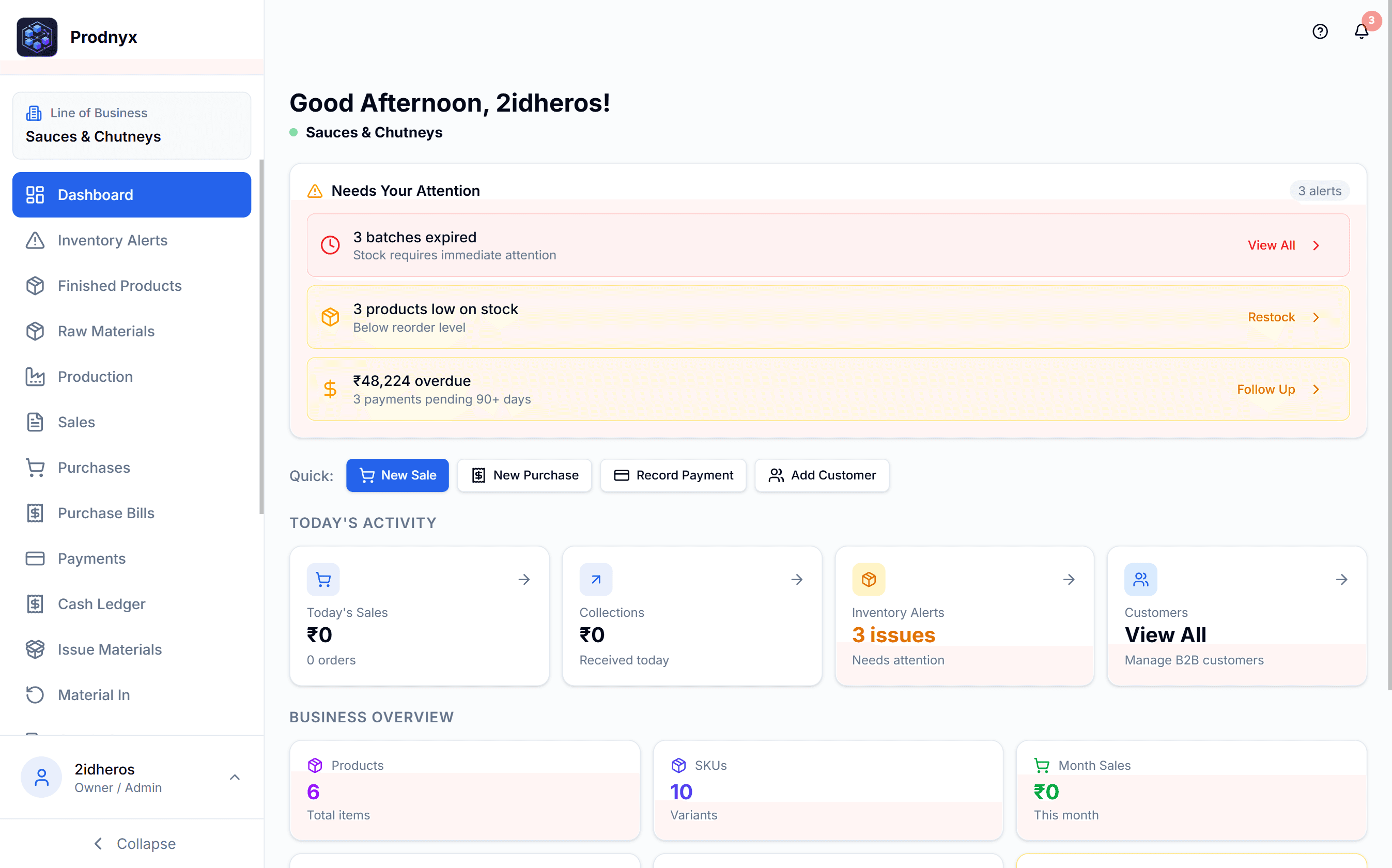
Prodnyx (our product) is built around a conviction: small factories deserve the same financial-grade inventory ledger and batch traceability that enterprise systems have, without the enterprise implementation. Every stock movement is a ledger transaction; every batch carries its expiry; FEFO picking is enforced by the system rather than by memory (see FEFO vs FIFO for why that matters); and analytics run on live ledger data.
- Strengths: batch/expiry traceability done properly, real-time wastage and yield visibility, cloud-based with setup in days, free Starter tier, with Indian small manufacturers as a core market.
- Trade-offs: it deliberately covers factory operations — not company-wide finance or HR. If you want one suite for everything, look at Odoo below.
- Fit: food, pharma, cosmetics, chemicals, and any small/mid factory where lots, expiry, and material wastage are real money.
Katana — for makers selling online
Katana shines when manufacturing meets e-commerce: make-to-stock planning with live inventory commitments, and first-class integrations with Shopify and similar channels. If your factory's demand arrives as web orders, its planning view is excellent. Batch/expiry handling and deep traceability are lighter than dedicated systems, and subscription cost grows with your team.
MRPeasy — classic MRP, kept small
MRPeasy is what traditional MRP looks like when honestly scaled down: routings, work centers, production scheduling, and purchasing planning in a straightforward cloud app. Factories with genuine multi-step routing and capacity questions get real value. The interface feels utilitarian, and per-user pricing means costs rise as you bring the floor onto the system.
Odoo — maximum breadth, if you'll invest in it
Odoo is a modular open-source suite where manufacturing is one app among dozens — add accounting, CRM, purchasing, HR as needed. The breadth is unmatched at the price. The honest catch: Odoo rewards teams with configuration capacity (or a local implementation partner) and punishes those without; "we'll set it up ourselves next month" is where many Odoo projects stall.
Fishbowl — the QuickBooks specialist
Fishbowl built its reputation as the manufacturing/warehouse layer for QuickBooks-centric businesses, mostly in North America. If your accounting world is QuickBooks and you want inventory that speaks it natively, it's a proven choice — at the cost of heavier setup and a less modern, less cloud-native experience than the others here.
How to choose in one afternoon
- Write your dealbreaker first. Expiry-dated materials? Traceability leads. Web-order demand? Planning integrations lead. One-suite ambition? Breadth leads.
- Demo with your own data — your top 10 materials, one real production order, one real purchase. Sample data hides every weakness.
- Check the total cost at your real user count, not the teaser tier.
- Ask about India specifics if you're here — support hours, pricing currency, and whether anyone answers WhatsApp.
And if batch traceability, wastage visibility, and honest small-factory pricing are your dealbreakers — that's exactly the brief Prodnyx was built to. The Starter tier is free, so you can run it against this checklist yourself. For the broader digitization journey, our factory digitization checklist maps the steps.
Frequently asked questions
- What is the best factory management software for a small manufacturer?
- It depends on your priority: Prodnyx for batch traceability and ledger-grade inventory at small-factory prices (with a free tier), Katana for e-commerce-connected make-to-stock workflows, MRPeasy for classic lightweight MRP planning, Odoo for maximum modular breadth if you have implementation help, and Fishbowl for deep QuickBooks-centric inventory.
- How is factory management software different from ERP?
- Factory management software focuses on the production floor — inventory, batches, work orders, traceability — and deploys in days. ERP suites add finance, HR, and procurement across the whole company but cost more and take months to implement. Most small factories need the floor solved first.
- How much does factory management software cost for a small factory?
- Cloud systems for small manufacturers typically run from free or entry tiers up to a few hundred dollars (or a few tens of thousands of rupees) per month depending on users and modules — one to two orders of magnitude below traditional ERP implementations.
- Do small factories really need batch traceability?
- If you handle anything with expiry dates, quality variance between lots, or recall risk — food, pharma, cosmetics, chemicals — batch traceability is the difference between recalling one lot and recalling everything. For durable-goods factories it's less critical, and simple quantity tracking may suffice.
Ready to launch fast and scale smart?
Kaelix Technologies builds rapid, AI-powered software for growing businesses. Tell us your workflow and we'll show you what's possible.