Reduce Material Wastage in Manufacturing: 7 Proven Steps
Material wastage quietly eats 5-15% of many small factories' margins. Seven practical steps — from batch tracking to FEFO — to find and stop the leaks.
Ask a small manufacturer what their material wastage is, and you'll usually get one of two answers: a suspiciously round number, or an honest "we don't really know." Both answers cost money. Across small and mid-size factories, unmeasured wastage routinely consumes 5–15% of material spend — which, for most operations, is more than the entire net margin on some product lines.
The good news: material wastage isn't one big problem. It's five or six small, boring leaks — and each one has a known fix. Here are seven steps that work, in the order we'd apply them.
1. Start measuring before you start fixing
You can't reduce what you can't see. The foundation is a stock ledger: every receipt, every issue to production, every return, every write-off recorded as a transaction, against a specific material and batch.
With a ledger in place, wastage stops being a guess and becomes a report:
- Yield variance — materials issued vs. what finished output should have consumed.
- Expiry write-offs — stock that died on the shelf.
- Damage and shrinkage — recorded losses and unexplained gaps.
If you're currently on spreadsheets, this is the step where they break down — a spreadsheet records balances, not movements. (Our guide to what factory management software actually does covers the ledger concept in depth.)
2. Switch perishables from FIFO to FEFO
If any of your materials carry expiry or best-before dates, plain first-in-first-out rotation will systematically strand your shortest-dated stock. FEFO — First-Expired-First-Out — issues the nearest-expiry batch first, which is the single most direct fix for expiry write-offs.
FEFO needs batch-level tracking to work, which is why factories that adopt it usually do so together with step 1. We've written a full comparison in FEFO vs FIFO inventory if you're weighing the switch.
3. Issue against production orders, not on request
In many factories, materials leave the store because someone asked for them. That informal flow is where over-issuing hides: a little extra "to be safe", the remainder never returned, nothing reconciled.
The fix is to make production orders the unit of issue:
- Each order specifies expected material consumption (a simple bill of materials is enough).
- The store issues against the order, not against a person.
- Excess issues are visible immediately as variance on that order.
This one change turns "material disappeared" into "order #142 consumed 8% over standard — why?", which is a question you can actually investigate.
4. Put numbers on damage and handling losses
Damage in storage and handling feels random, but recorded over a few months it always shows patterns: one racking area, one material type, one shift. Make write-offs a first-class transaction with a reason code — expiry, damage, spillage, QC rejection — and review the totals monthly.
Factories are often surprised to find that two or three reason codes explain most of the loss, and each points at a cheap fix: better containment, a storage change, or retraining one process step.
5. Fix the count so purchasing stops over-buying
Inaccurate stock records cause a second-order wastage: over-purchasing. When nobody trusts the recorded balance, buyers pad orders — and padded orders become aging stock, which becomes expiry write-offs, which makes the recorded balance even less trustworthy.
Breaking the cycle requires accurate, real-time balances (steps 1–3 deliver this) plus cycle counting: counting a small slice of items weekly instead of one painful year-end stocktake. Accuracy compounds — once buyers trust the number, safety padding shrinks and old stock stops accumulating.
6. Watch yield variance per product, not per factory
A factory-wide wastage percentage hides everything interesting. The actionable view is yield variance per product per period: which items consistently consume more material than their standard, and whether that variance is drifting.
Per-product variance catches things a global number never will — a worn die on one line, a supplier whose material runs thinner, an operator who needs training on one setup. Real-time analytics on ledger data make this a five-minute weekly review instead of a quarterly archaeology project.
7. Close the loop with monthly wastage reviews
None of the above sticks without a rhythm. A 30-minute monthly review is enough:
- Total wastage by reason code — trending down?
- Top 5 products by yield variance — anything new?
- Near-expiry stock report — what needs to move this month?
- One corrective action assigned, from last month's biggest leak.
Factories that hold this review consistently report wastage reductions of 30–50% within two or three quarters — not from any single dramatic fix, but from leaks no longer being invisible.
The role of software (honestly stated)
Software doesn't prevent a spill or stop a batch from expiring. What it does is make every one of the steps above cheap enough to actually do: the ledger is automatic, FEFO is enforced at picking, orders carry their own variance, write-offs take ten seconds to record, and the monthly review is a dashboard instead of a data-gathering project.
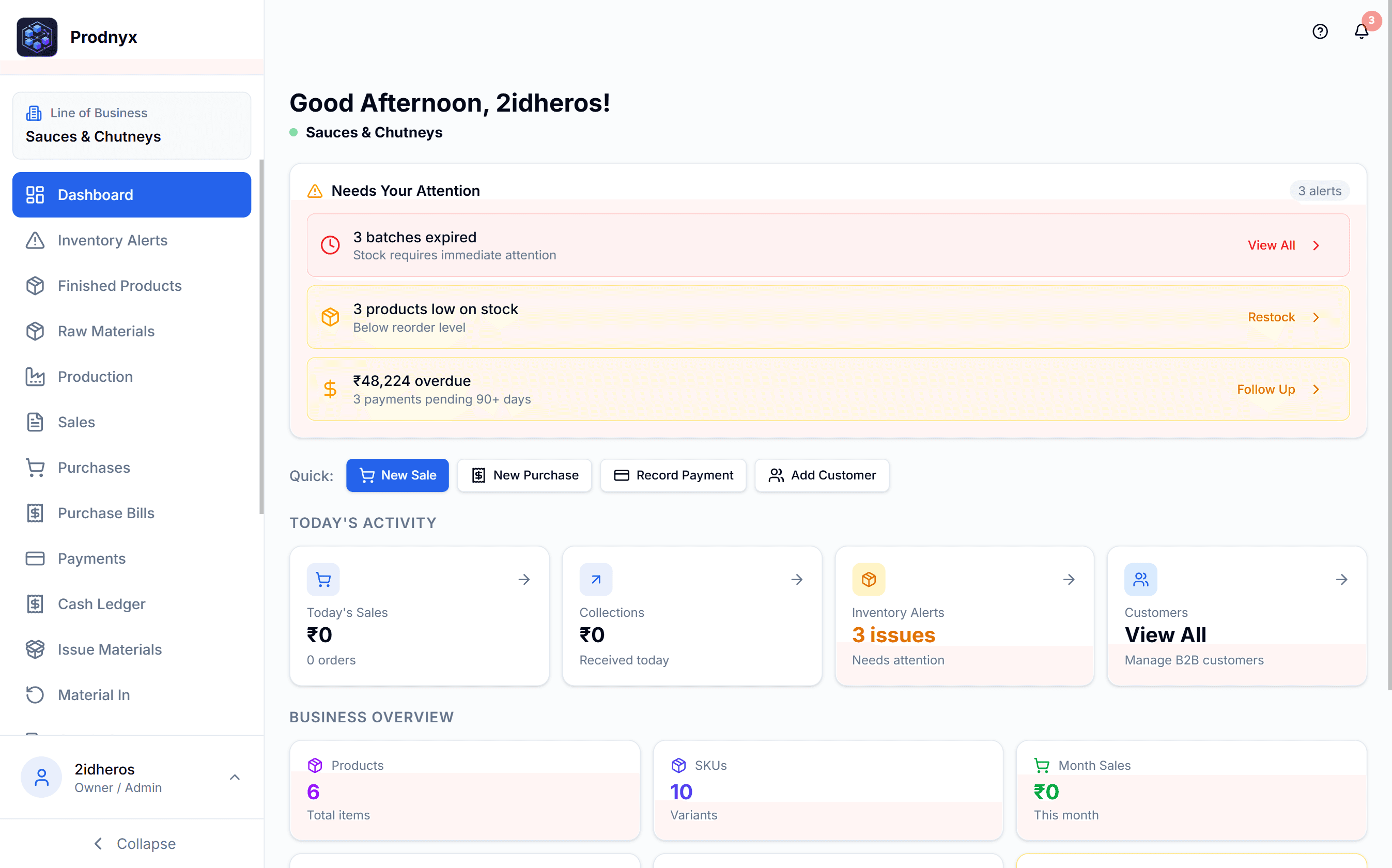
That's the philosophy behind Prodnyx, our factory management platform — financial-grade inventory tracking, batch-level FEFO traceability, and production workflows with real-time analytics, built for small and mid-size manufacturers. There's a free Starter tier, so you can put the measurement foundation in place before spending anything.
Start with step 1 this week. Every other step gets easier the moment the leaks have numbers on them.
Frequently asked questions
- What are the main causes of material wastage in manufacturing?
- The most common causes are expiry of perishable stock, over-issuing against production orders, damage in storage and handling, unrecorded consumption (shrinkage), and over-purchasing driven by inaccurate stock records.
- How do you measure material wastage in a factory?
- Track the difference between materials issued and materials actually consumed by finished output (yield variance), plus stock written off to expiry or damage. You can only measure this reliably when every issue and receipt is recorded against batches in a stock ledger.
- Can software really reduce material wastage?
- Yes — indirectly but powerfully. Software doesn't stop a spill, but it makes every movement visible: it flags near-expiry batches, enforces FEFO picking, catches over-issues against orders, and shows yield variance per product, so leaks are found in days instead of at year-end stocktake.
- What is a good wastage percentage in manufacturing?
- It varies widely by industry — food processors may accept 2-5% while precision manufacturing targets under 1%. The useful benchmark is your own trend: measure current wastage honestly, then drive it down month over month.
Ready to launch fast and scale smart?
Kaelix Technologies builds rapid, AI-powered software for growing businesses. Tell us your workflow and we'll show you what's possible.