Factory ERP for Small Manufacturers: Options & Costs (2026)
The factory ERP options a small Indian manufacturer can actually afford, TallyPrime, ERPNext, Odoo and SAP Business One, with rupee prices and the costs vendors leave out.
TL;DR: A small Indian factory has four factory ERP routes. TallyPrime costs a one-time Rs.22,500 to Rs.67,500 plus GST and is strongest on books. ERPNext is free software you pay someone to set up. Odoo is about Rs.725 per user a month. SAP Business One is quote-only through partners. The licence is the small cost; setup, data cleanup and training are the big ones. If your real problem is stock and production on the floor, start with floor software, not a full ERP.
Your stock register says one thing, the floor says another, and month-end is a week of reconciling the two. That's usually the moment someone says you need a factory ERP. Sometimes they're right. Often the gap lives in one place, the stores and the production floor, and a full ERP is a large purchase to fix it.
This guide is for owners of factories with roughly 10 to 200 people who are pricing an ERP for the first time. It covers what a factory ERP actually is, the shop-floor jobs it must handle in India, the four options a small manufacturer can realistically afford, and what each one costs once you add the work vendors don't quote. We also make Prodnyx, which is factory software and not an ERP. We'll say where that matters and where it doesn't.
What is a factory ERP?
A factory ERP is an ERP (enterprise resource planning) system set up for a manufacturer. It keeps bills of materials, production orders, inventory, purchasing, sales and GST accounting in one database. The point is that one event, like issuing steel to a press, updates stock, job cost and the books at once, with nobody typing it twice.
That last part is what separates an ERP from a stack of separate tools. With separate tools, someone in the office re-enters the floor's paper slips into accounting, and the two drift apart. An ERP removes that re-entry by making the floor entry and the accounting entry the same record.
The catch is scope. An ERP covers the whole company: finance, purchase, sales, often HR and payroll. You pay for that breadth in licences, setup time and training, whether or not your factory needed all of it.
What a factory ERP must handle on your shop floor
A factory ERP for an Indian plant should handle six things before anything else: multi-level bills of materials, production orders with material issued against them, batch and expiry tracking, job work sent to outside processors, GST e-invoicing, and stock entry from a phone on the floor. A system that misses any of these will push that work back onto paper.
Use this as your demo checklist:
- Multi-level bills of materials. A BOM (the recipe listing every input for one finished item) often has sub-assemblies inside it. Ask the vendor to build one of your real products, two levels deep, in the demo.
- Production orders with material issued against them. Material should leave the stores against a specific order, so you can see what each job actually consumed versus the BOM.
- Batch, lot and expiry tracking. If your inputs expire, you want stock issued by FEFO (first-expired, first-out), not whatever is nearest the door.
- Job work. If you send goods to outside processors for plating, machining or packing, the system must track what's out and what came back. GST requires a return for this: the GST portal's ITC-04 manual sets it as half-yearly above Rs.5 crore turnover and yearly below.
- GST e-invoicing and e-way bills. E-invoicing is mandatory once your aggregate turnover has crossed Rs.5 crore in any year since 2017-18, under Notification 10/2023, listed on the official e-invoice portal. If you're over that line, the ERP must generate e-invoices, not just print bills.
- Entry from the floor. Store and line staff work on mid-range Android phones, often with patchy Wi-Fi. If every entry needs an office PC, entries will be batched at day's end, and your "real-time" stock will be a day old.
Two things can wait: advanced scheduling and the planning module that works out what to buy from your orders. They matter, but only once your stock numbers are trustworthy.
Factory ERP options for Indian small manufacturers
These are the four routes most small Indian factories actually shortlist. They're very different products, so compare them on fit before price.
TallyPrime: books first, manufacturing added
Many Indian factories already keep their accounts in TallyPrime, which is its biggest advantage: your accountant knows it. It handles GST, inventory and manufacturing entries, including bills of materials and job work in and out. Tally sells it as a one-time licence, and Tally's own cost-of-ownership breakdown puts Silver (one user) at Rs.22,500 and Gold (multi-user) at Rs.67,500, plus GST.
Where it's thinner is production planning. Tally records what was manufactured well. It does less to plan what should be manufactured, track work in progress across stages, or show a supervisor today's open orders on the floor.
ERPNext: free software, paid setup
ERPNext's manufacturing module has the full set: bills of materials, work orders, production planning and subcontracting. The software is open source and free. Frappe's ERPNext pricing page lists cloud hosting from Rs.410 a month for a site, with no per-user fee.
The honest catch is setup. ERPNext is flexible, which means someone has to configure it for your items, your routes and your reports. Most small factories hire an implementation partner, and that partner, not the hosting, is your real cost.
Odoo: polished suite, priced per user
Odoo's Manufacturing app sits alongside inventory, purchase, accounting and a lot more, all on one plan. Odoo's published per-user pricing for India is Rs.725 per user a month on the Standard plan billed yearly, with a first-year discount to Rs.580. If you need customisation through Odoo Studio, you move to the Custom plan at Rs.1,350 per user a month.
Odoo is easier to start than ERPNext and has more modules than most small factories will ever open. Per-user pricing is the thing to model: every stores clerk and supervisor who logs in is a paid seat. Staff who only use the shop-floor or barcode screens can be cheaper "light users" at Rs.195 a month, arranged through an Odoo advisor.
SAP Business One: the established name, sold through partners
SAP Business One is SAP's ERP for small and mid-size companies. You can't buy it from SAP directly; SAP's Business One page routes you to a quote, and it's sold and implemented through certified partners. It's a serious, proven system, and it's priced like one. Ask for the licence, the implementation and the yearly support as three separate lines in the quote.
A different category: floor-first factory software
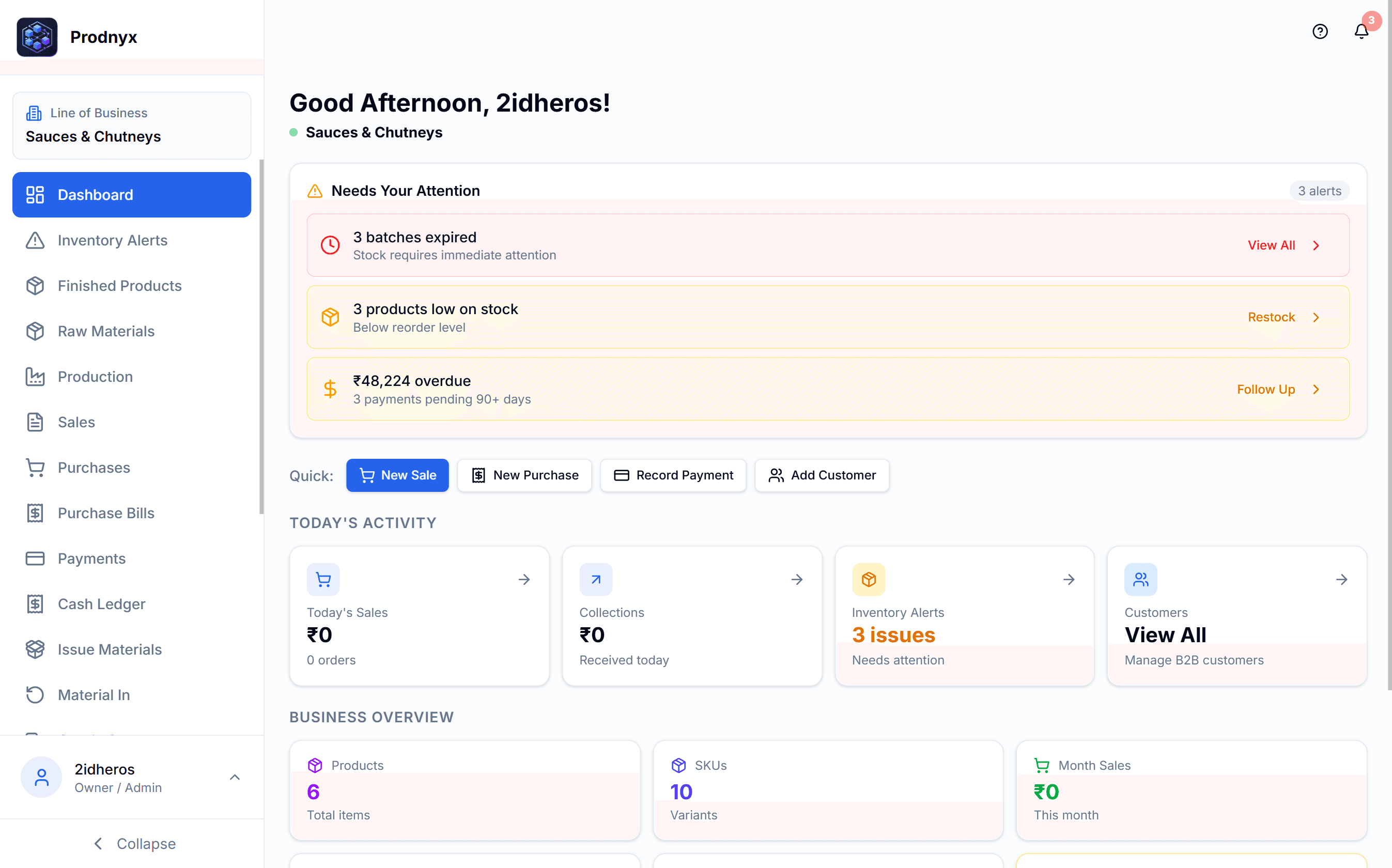
There's also software that isn't an ERP at all: tools built for stock, batches and production on the floor, which leave accounting to Tally. Katana, MRPeasy and our own Prodnyx sit here, and our comparison of factory management software covers them side by side. This route only makes sense if your books are already fine and the floor is the problem.
How much does a factory ERP cost in India?
For a five-user factory, factory ERP licences range from a one-time Rs.67,500 plus GST (TallyPrime Gold) to roughly Rs.3,600 a month (Odoo Standard), with ERPNext hosting from Rs.410 a month. The licence is rarely the big number. Implementation, data migration and training usually cost more than the first year of licences.
Here's what each option costs at five users, from the vendors' own pricing pages:
| Option | How it's priced | Five users | What's not included |
|---|---|---|---|
| TallyPrime | One-time licence | Rs.67,500 + GST (Gold, multi-user) | Yearly software-services renewal; setup by a Tally partner if needed |
| ERPNext | Free software, pay for hosting | From Rs.410/month hosting, no per-user fee | Implementation partner, customisation, training |
| Odoo | Per user per month, billed yearly | Rs.3,625/month (Standard); Rs.2,900 in year one | Implementation (Odoo's Success Packs or a partner) |
| SAP Business One | Licence via certified partners | On quote | Partner implementation and yearly support |
Prices checked on each vendor's pricing page on 5 November 2026. Confirm GST and what the quote covers before you sign.
The costs that don't appear in that table are where budgets break. Panorama Consulting's 2026 ERP Report found that more than a quarter of organisations went over their ERP project budget. That survey isn't of small Indian plants, but the reasons projects run over are familiar at any size: scope grows, data turns out messier than expected, and consultants bill more hours.
For a small factory, budget for four things beyond the licence:
- Item master cleanup. The same raw material entered as "MS Sheet 2mm", "M.S. sheet 2 mm" and "Sheet-2" is three items to any software. Fixing this is unglamorous and usually the longest job.
- Opening stock. Someone has to physically count and enter it, batch by batch.
- Partner or consultant time. Configuration, reports and the inevitable "can it also do this?" requests.
- Training and the dip. Expect a few weeks where entries are slower and errors are higher while staff learn.
Factory ERP or factory management software?
Choose a factory ERP when your main problem is that finance, purchase, sales and production don't share data. Choose factory management software when your main problem is the floor itself: stock that doesn't match, material you can't trace to a batch, and production you can't see until the day ends. Many small factories have the second problem and buy for the first.
A quick test: if your accountant is happy with Tally but your stores register is a mess, an ERP will move that mess into a more expensive system. Fix the floor first, keep Tally for the books, and revisit ERP when cross-department integration is genuinely what's slowing you down.
We go deeper on scope, cost and timelines in the full ERP vs factory software comparison.
How to choose a factory ERP without a failed rollout
The safe order is process first, software second. Buying before you've mapped how work actually moves is how rollouts stall. These six steps keep the order right.
- Trace one real order end to end. Take last week's biggest job, from purchase order to dispatch, and write down every slip, register and spreadsheet it touched. That map is your requirement list. Vendor feature lists are not.
- Clean your item names before you migrate. Agree one naming rule for materials and finished goods, then apply it. Our factory digitization checklist puts this step first for a reason.
- Demo with your own data. Bring 20 real items and one real BOM. If the vendor can only show their sample company, you haven't seen the product.
- Insist on a stock ledger with an audit trail. Every stock change should be a dated transaction someone made, not an editable balance. If a user can overwrite a stock figure without leaving a trace, traceability is gone.
- Check GST and job work in the demo. Ask them to raise an e-invoice and send material out for job work, live. These are where generic ERPs built for other markets fall over in India.
- Pilot one line before the whole plant. Run one production line for a month. If entries are falling behind at that scale, they'll collapse at full scale.
Where this leaves you
Three things to take away:
- A factory ERP is worth it when finance, purchase and production all need to share one record. If only the floor is broken, it's an expensive way to fix it.
- The licence is the smallest cost. Item cleanup, opening stock, partner time and training decide whether the project lands.
- Demo with your own BOM, your own items and a live e-invoice. That hour tells you more than any feature list.
One thing we'd tell you even though it doesn't help us: Prodnyx is not an ERP. It doesn't run your accounts, file GST or do payroll, so if joining finance to production is your real need, ERPNext, Odoo or Tally will serve you better.
If the floor is the problem, here's what floor-first software looks like built. Prodnyx keeps a stock ledger where every movement is a dated transaction, tracks batches by FEFO, and issues material against production orders, while your accounts stay where they are. There's a free trial. And if you'd rather talk your process through before choosing anything, book a free scoping conversation. We reply within 24 hours on business days and will tell you plainly if an ERP is the better fit.
Frequently asked questions
- What is a factory ERP?
- A factory ERP is an ERP (enterprise resource planning) system set up for a manufacturer. It keeps bills of materials, production orders, inventory, purchasing, sales and GST accounting in one database, so a material issued on the floor shows up in stock and in costing without being typed twice.
- Is TallyPrime an ERP?
- TallyPrime is accounting-first business software with inventory and manufacturing features added, including bills of materials and job work. It covers what many small factories need for books, GST and stock. It is lighter than a full ERP on production planning, which is where ERPNext or Odoo go further.
- Which ERP is best for a small manufacturing company in India?
- It depends on where your problem sits. If your books and GST are the priority, TallyPrime is the common starting point. If you want an open-source ERP with real manufacturing modules and can pay an implementation partner, ERPNext fits; if you want a polished cloud suite priced per user, Odoo fits. If stock and production on the floor are the actual problem, floor-first factory software is usually faster and cheaper than any ERP.
- How long does a factory ERP take to implement?
- A narrow rollout covering stock and one production line can go live in weeks, while a full ERP with accounting, purchasing and production usually takes months. Overruns are common: Panorama Consulting's 2026 ERP Report found that more than a quarter of organisations went over their project budget. Data cleanup and training are what stretch the timeline, not the software.
- Is ERPNext really free?
- The ERPNext software is free and open source, and Frappe's own cloud hosting starts at Rs.410 a month with no per-user fee. What isn't free is the work around it: setting it up for your products and processes, migrating data and training staff. Most small factories pay an implementation partner for that.
Have a workflow off-the-shelf tools don't handle?
Kaelix Technologies builds, secures and automates the systems businesses rely on, from scoped security testing and workflow automation to ValloraQ, Prodnyx and EstateXcell. Tell us your workflow and we'll show you what's possible.